

Headlines
- Gas and Electricity Wholesale prices are higher than last month.
- Little confidence that a lasting peace deal will be agreed in the short term.
- EU Gas Storage is just 65% full, which is a concern as we approach winter.
Energy Overview
As of the 31st of August, Gas and Electricity Year Ahead Wholesale costs were higher than last month. Oil is currently higher at $92 from $85.
As of the 1st of September, prices are increasing due to renewed hostilities between the US and Iran. Attempts to find peace continue, but with little confidence that a deal will be agreed in the short term, as the focus has switched from military action to sanctions.
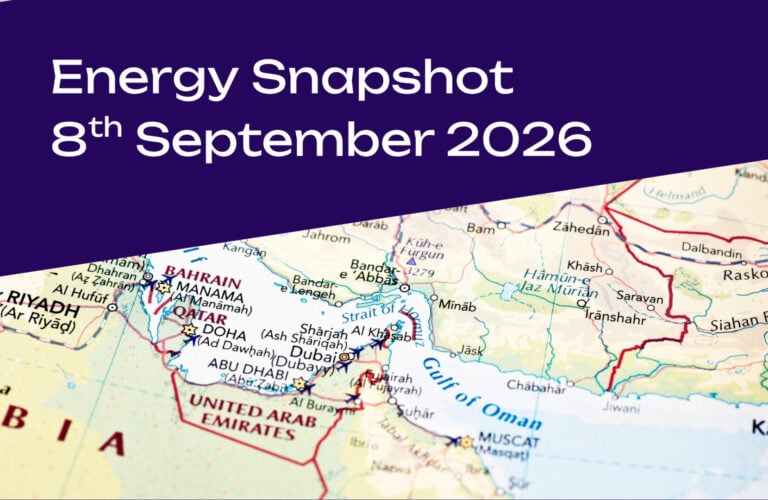
The disruption of LNG supplies through the Strait of Hormuz means cancelled scheduled deliveries and more global competition, notably between Europe and Asia.
Energy markets are increasing premiums for Gas for the winter period, showing much better value for contracts starting in 2027 and 2028. This provides an opportunity to dilute 2026 start costs, by contracting for longer.
Other Industry Costs
April 2026 saw a large increase in Electricity Transmission costs with an expectation of further annual increases. Distribution costs are a little more complicated, made up of Time of Use, Available Capacity and Fixed charges. Some of these charges are now based on a meter’s Band, which is related to a Half Hourly meter’s kVA Capacity. This means that by managing demand and reviewing the Capacity, there is an opportunity to reduce costs. Indigo Swan can provide you with guidance through this process.
The cost to Balance the network is increasing as is the Energy Intensive Industries (EII) charge, which provides relief from various industry costs for EII customers. This moved from 60% to 90% for the Network costs from April 2026.
Gas Market Overview
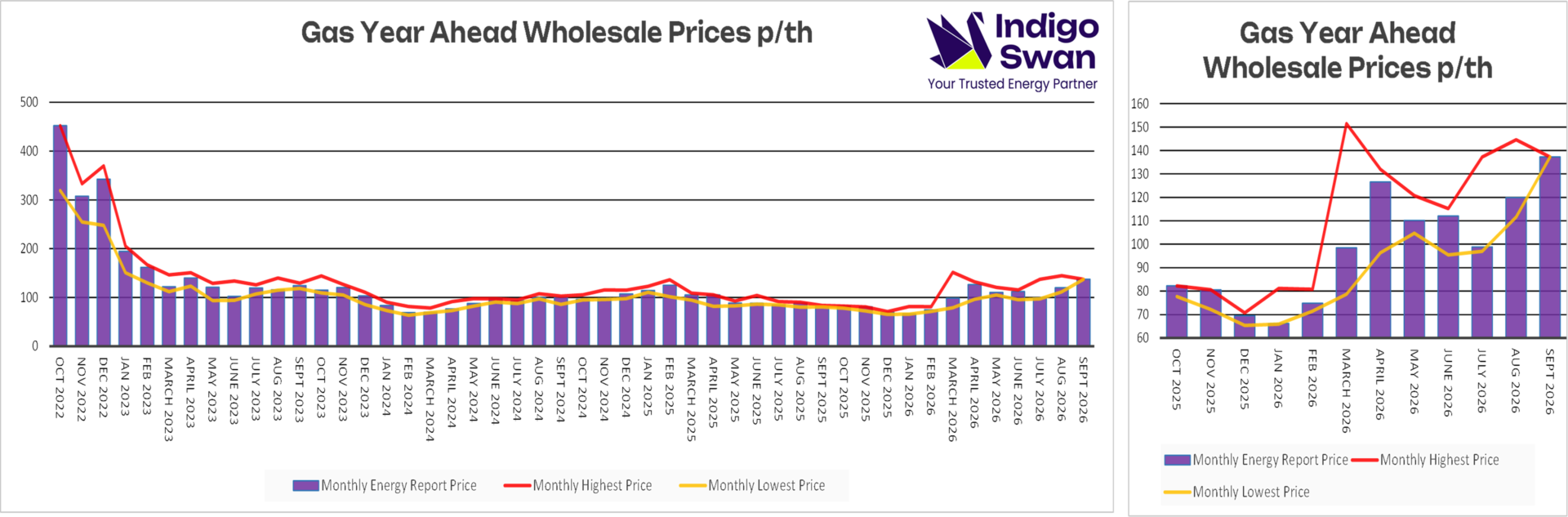
On the 31st of August, the Gas Year Ahead Wholesale cost was 137.24p/th, up from 119.89p/th in last month’s report and 68% higher than 2025.
Today, the 1st of September, is seeing prices move higher, largely due to the resumption of military strikes between the US and Iran over the weekend.
There are reports of some ships making the journey through the Strait of Hormuz, but it does effectively remain closed. This is having a significant impact on global Gas supplies, with Qatar cancelling contracted deliveries to Europe and Asia. This means increased competition for LNG, resulting in higher prices.
Low EU Gas Storage is also adding pressure to prices. At just 65% full compared to 77% in 2025 and 92% in 2024, there is a concern for supplies through winter 2026 / 2027. There will also be less Gas available from January 2027, when a complete EU ban on Russian LNG is enforced.
Temperatures across Europe are falling from the recent highs. Gas generation has been supporting pressured Electricity supplies. This may allow additional Gas to be diverted into Storage.
We would encourage any customer with a contract that ends in the next few months, to discuss your renewals with us and we will look to provide additional market intelligence, guidance and support as required.
Electricity Market Overview
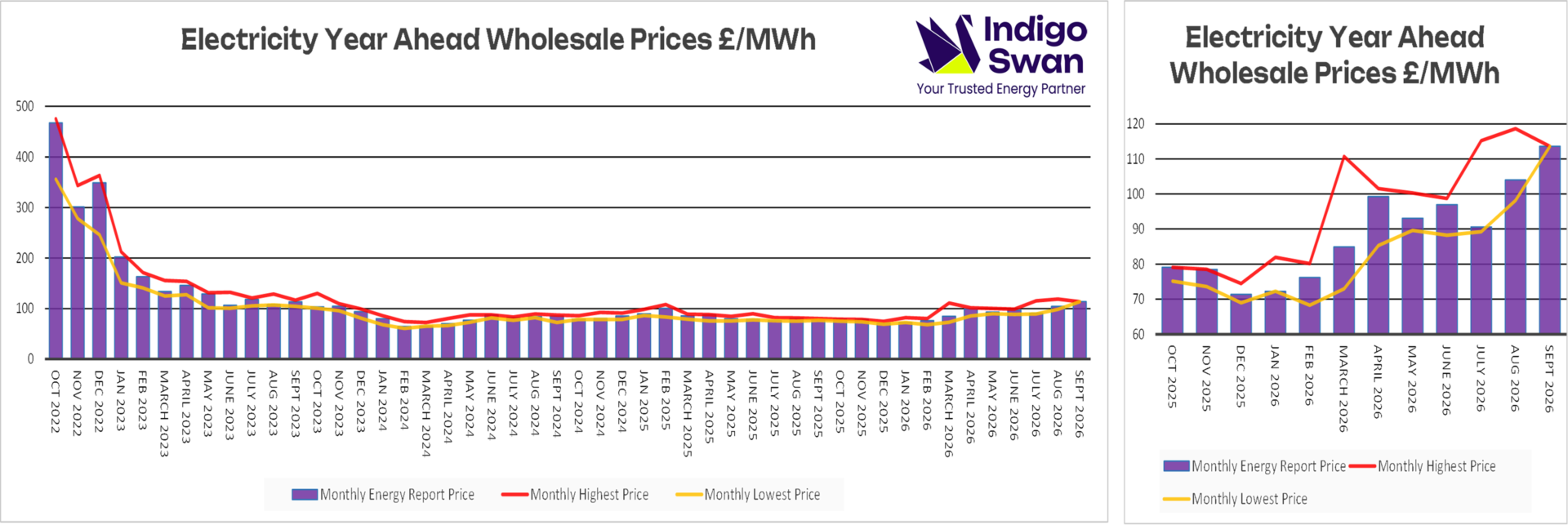
On the 31st of August, the Electricity Year Ahead Wholesale cost was £113.62/MWh, up from £104.03/MWh in last month’s report and 46% higher than 2025.
Today, the 1st of September, is seeing prices move higher, largely due to the resumption of military strikes between the US and Iran over the weekend.
Gas contributed 23% of generation in August, and being the most expensive fuel, generally sets the direction of Electricity Wholesale prices. Until LNG deliveries can pass safely through the Strait of Hormuz, then Electricity costs are likely to remain inflated. There is currently little sign that a lasting deal will be agreed between the US and Iran, although efforts continue.
Generation across Europe has been impacted by high temperatures and low water levels. With milder conditions, there should now be some improvement, although France is still experiencing issues with Nuclear assets, due to low river levels.
In August, the UK imported in the region of 17% of Electricity from mainland Europe, down from 21% in July. Wind contributed 20%, which is much lower than the 32% seen during the winter months.
We would encourage any customer with a contract that ends in the next few months, to discuss your renewals with us and we will look to provide additional market intelligence, guidance and support as required.
If you enjoyed reading this blog why not try one of our others: