

Headlines:
- Gas and Electricity Wholesale prices are higher than last month
- Prices are lower today as tensions ease in the Middle East
- EU Gas Storage remains low at just 40% full
Energy Overview
As of the 1st of June, Gas and Electricity Year Ahead Wholesale costs were higher than last month. Oil was lower at $94 from $114.
Today, Gas prices are moving lower following increases on Monday when Iran suspended communications with the US due to Israel’s military action in the region. President Trump acted to try to de-escalate.
The stalemate between the US and Iran continues, with the ceasefire holding as negotiations take place. There is now a pattern of the US expressing optimism that a deal is close, which is followed by Iran being dismissive. The US attacking Iran claiming self-defence and Iran retaliating by striking its neighbours. Each instance has seen upward and downward market movement. Although talks seem to be making progress, there are points that neither party seems willing to concede, which makes it likely that the disruption to energy supplies will continue through 2026 and beyond, due to the damage sustained to infrastructure and the need to clear mines from the Strait of Hormuz. A direct result in the UK has been the increase in the domestic Energy Price Cap from July 2026 by £221 a year.
The eventual scale of increases and over what period is very much an unknown, but we will continue to be available to discuss options and provide guidance.
Other Industry Costs
The energy industry has changed how it recovers Electricity Distribution, Transmission and Balancing costs, under the Targeted Charging Review. This has moved some charges away from being based on the energy used and billed in the unit rate, to fixed charges incorporated within the Standing Charge or as separate items. This should give both the customer and the industry a more accurate way of calculating budgets, but the change has become noticeable within energy bills and created concern.
From April 2026 customers will have seen a large increase in Transmission costs with an expectation of further annual increases at least for the next five years. Distribution costs are a little more complicated, made up of Time of Use, Available Capacity and Fixed charges. Some of these charges are now based on a meter’s Band, which is related to a Half Hourly meter’s kVA Capacity. This means that by managing demand and reviewing the Capacity, there is an opportunity to reduce costs. Indigo Swan can provide you with guidance through this process.
The cost to Balance the network is increasing as is the Energy Intensive Industries (EII) charge, which provides relief from various industry costs for EII customers. This moved from 60% to 90% for the Network costs from April 2026.
Indigo Swan works closely with energy suppliers to help all our customers understand and manage changes.
Please contact us on 0333 320 0475 to discuss options or to get a latest update.
Gas Market Overview
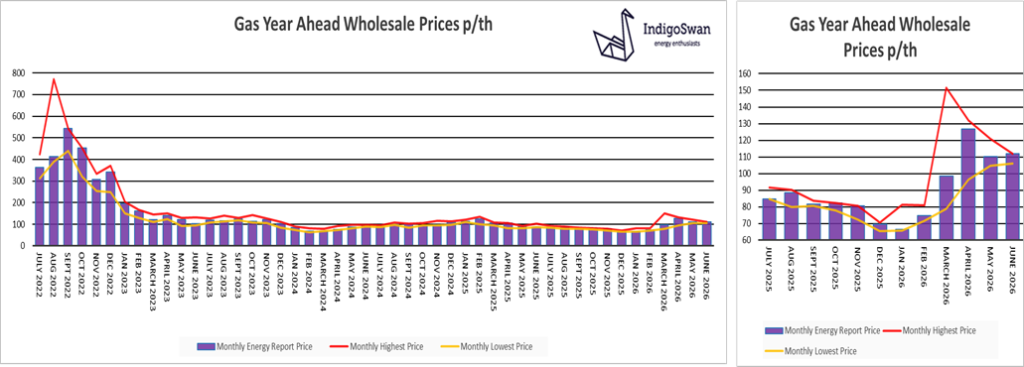
On the 1st of June, the Gas Year Ahead Wholesale cost was 112.07p/th, up from 110.15p/th in last month’s report and 27% higher than 2025. Today, the 2nd of June, is seeing prices move lower following the increases on the 1st, when Iran expressed concern at Israel’s military activities, threatening the fragile peace process.
The disruption to 20% of global LNG through the Strait of Hormuz, continues to be the main influence on Gas costs. Generally, the US supplies Europe, and the Middle East and Australia supply Asia, but some LNG will be directed to the highest bidder. There is also an unresolved issue in Australia, which is the third largest exporter of LNG. Workers are threatening more widespread industrial action, which could add further price volatility. Longer term we may see that once the disputes in the Middle East and Ukraine have been resolved, that there is a greater resilience, more investment bringing new LNG facilities online, and potentially less reliance on shipments through the Strait of Hormuz.
The EU’s Gas Storage is slowly being refilled, at just 40% full compared to 48% last year and 70% in 2024. There will also be less Russian LNG due to a partial ban from April 2026 and a full ban from January 2027. Although it is unlikely that there will be Gas shortages through the winter, energy markets closely monitor Storage and add risk premiums.
We would encourage any customer with a contract that ends in the next few months, to discuss your renewals with us and we will look to provide additional market intelligence, guidance and support as required.
Electricity Market Overview
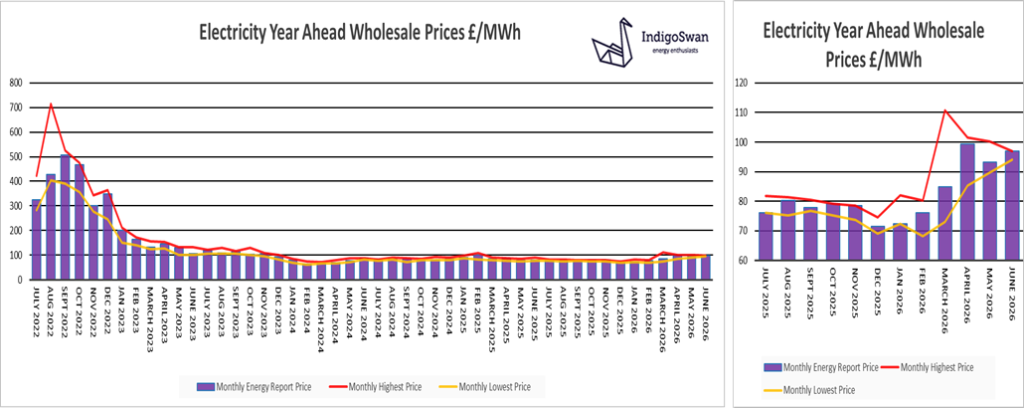
On the 1st of June, the Electricity Year Ahead Wholesale cost was £96.96/MWh, up from £93.12/MWh in last month’s report and 23% higher than 2025. Today, the 2nd of June, is seeing prices move lower following the increases on the 1st, when Iran expressed concern at Israel’s military activities, threatening the fragile peace process.
The direction of our Wholesale Electricity prices is still being heavily influenced by Gas, due to its use for generation and high cost. This is despite the growing number of Renewable assets and the increasing diversity of supplies. The additional challenge for Electricity is the huge investment needed to ensure we have enough generation and the infrastructure to connect the network to achieve Net Zero. These costs are being seen in our customer’s contract renewals. To attempt to counter some of these increases, we encourage a review of costs associated with Half Hourly metering.
In May, Wind accounted for 21% of supplies and Gas 24%, up from 17% in April. The Interconnectors with mainland Europe, which allow both Imports and Exports, provided 20%.
We would encourage any customer with a contract that ends in the next few months, to discuss your renewals with us and we will look to provide additional market intelligence, guidance and support as required.
If you enjoyed reading this blog why not try one of our others: