


Wholesale costs make up a smaller proportion of Electricity and Gas bills. Third Party charges are on the rise.
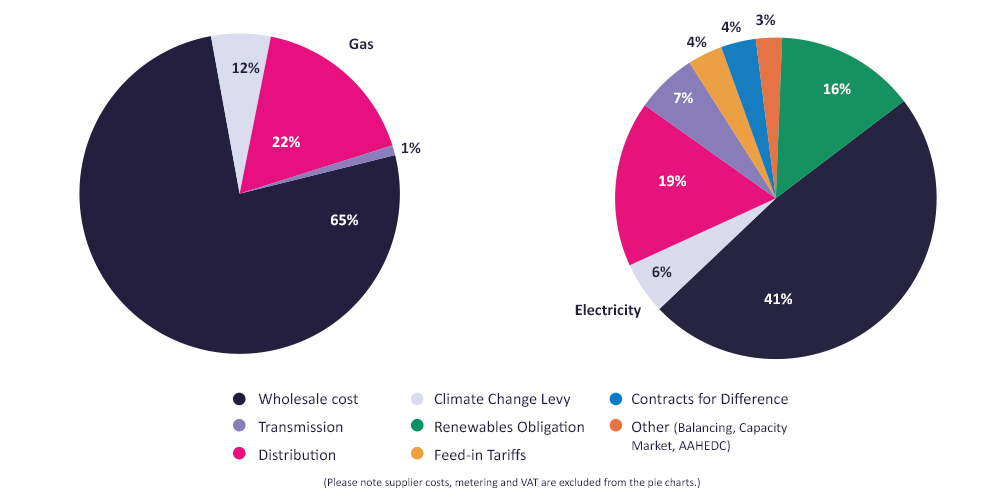
*Typical split and subject to individual requirements and location
Network Charges Transmission
Charges contribute towards the cost of building, maintaining and operating the high pressure Gas and high voltage Electricity transmission networks. Transmission companies charge the users of these networks and the costs get passed down to customers by energy suppliers. Suppliers and generators are also charged for balancing the system (termed Balancing and Use of System Charges).
Distribution Charges go towards the cost of building, maintaining and operating the local Gas pipes and Electricity wires which deliver energy to your business. Suppliers are charged for these costs by the distribution company and the cost gets passed on to consumers in Electricity or Gas bills.
Consumers in northern Scotland receive a partial rebate on their high distribution cost, which is paid for through a socialised charge on all other consumers in the form of the Assistance for Areas with High Electricity Distribution Costs (AAHEDC).
Green Subsidies
Renewables Obligation is a subsidy paid to support large-scale renewable Electricity projects in the UK. This closed to new entries in April 17 but continues to run until 2037. This has been replaced, for new schemes, by Contracts for Difference (CfD FiTs).
Feed-in Tariffs promotes the uptake of small-scale renewable and low-carbon generation technologies. From April 2019 this closed to new entrants and was replaced by the Smart Export Guarantee (SEG) from January 2020.
Levies & Taxes
Climate Change Levy (CCL) is a tax that businesses must pay through their Gas and Electricity bills. Companies with Electricity consumption under 12,000 kWh/year and Gas usage lower than 53,000 kWh/year are exempt, as are charities. From April 2019 the maximum discount was increased to 93% for Electricity and 78% for Gas through Climate Change Agreements (CCA), by agreeing to implement energy saving measures.
VAT for business consumers of energy is generally in-line with standard VAT rates, which currently stand at 20% (Please note the pie charts exclude VAT).
Supplier Costs
Costs to service customer accounts and profit is charged on an individual basis for non-domestic Electricity and Gas contracts. Suppliers assess their costs to serve individually with credit being a very important factor.
A cost is also factored in for the provision of metering services. This will vary depending on customers and site and typically makes up a very small fraction of the bill. (Please note Supplier Costs and Metering are excluded from the pie charts).
Other
From April 15 the Capacity Market (CM) and Contracts for Difference (CfD) were established to avoid Electricity supply issues.
The CM are a series of auctions to secure generation whilst CfD guarantees a fixed price to providers, regardless of the market conditions. The CfD replaces the Renewables Obligation for new schemes.
Energy Intensive Industries (EII) is a cost added to cover the subsidy paid to EII to reduce their exposure to RO, FIT and CfD, by up to 85%. The cost of these are recovered within Electricity invoices.
Wholesale Costs
Wholesale Gas and Electricity prices are a significant proportion of the overall cost of invoices.
There are a whole range of factors which contribute to whether they are high of low. Some of these are physical, such as reductions in Oil supplies, shortages or excess of Gas and Electricity, whilst others are classed as sentiment. These would be, for example, the potential for an unusually cold spell, rumours of deeper Oil production cuts or concerns that Nuclear generation may need to close due to safety concerns.
Indigo Swan analyse data daily, to help customers understand the wholesale market and provide guidance to make informed contract decisions.
How can I cut the size of my bill?
With all these pressures on prices, the trend could well be upward. Making sure you efficiently use energy is key. Do not simply renew your energy contracts with your current supplier but make them engage in a tender process. Also, use good market intelligence to contract at a time when the market suits you, rather than being forced into a last-minute decision.
Businesses with access to half hourly meters should also monitor their demand during “triad” charging periods (transmission) and red, amber green times (distribution) as a way of cutting costs. If you are able to shift your energy use away from early evenings on weekdays, you could make significant savings on your bills, although a change to the distribution calculations from April 2018 makes this slightly less appealing.
To minimise the scope for unexpectedly large bills, customers should carefully read all documents sent by energy suppliers. When looking at your bill try and understand which third-party charges are “all-inclusive” in your contracts and which are “pass-through”. It is likely some of your third-party charges will be pass through even if you think you have an “all-inclusive” Electricity contract.
We can help by providing an independent energy audit, giving you a report detailing what you use, how you use it and what you can do to lower it. The report is completely unbiased and is designed to be used as a tool for any future energy reduction projects. A typical audit for one site takes about a day and is not disruptive.
Please get in touch to find out more.