

Headlines:
- Gas and Electricity Wholesale prices are higher than last month
- EU Gas Storage levels are lower at 53% full compared to 69% last year
- Concern that Gas Storage levels may not be adequately replenished for winter 2025 / 26
Energy Overview
As of the 3rd of February, Gas and Electricity Year Ahead Wholesale costs were higher than in last month’s report.
Despite what looked like a potential downward price trend at the start of January, various issues, some domestic and others global, have once again created price volatility.
The main price driver continues to be the level of EU Gas Storage, which is now 16% lower than last year, at 53% full. With Russian Gas supplies via Ukraine ending in January 2025, Storage has helped compensate. Hungary and Slovakia are adding pressure to the EU and Ukraine to resume flows, which is unlikely, as Russia would profit by billions of pounds each year, funds that could be used in their war effort. Although alternate Gas transit options have been rumoured, which would likely involve a country buying Russian Gas and selling it to Europe, nothing has materialised. The premium being paid in Europe for Gas has attracted LNG shipments, with large numbers continuing to be from Russia, as the EU cannot apply sanctions whilst their supplies are so low.
Electricity’s price direction is being dictated by the use of expensive Gas for generation. This will continue until more Renewables are available, along with Storage to capture surplus supplies for future use. We will also need more Nuclear assets, a smarter grid and imports from the continent, if we are to break our dependence on Gas.
What does this mean for me?
The energy industry has changed how it recovers Electricity Distribution, Transmission and Balancing costs, under the Targeted Charging Review. This has moved some charges away from being based on the energy used and billed in the unit rate, to fixed charges incorporated within the Standing Charge or as separate items. This should give both the customer and the industry a more accurate way of calculating budgets, but the change has become noticeable within energy bills and created concern. Over the next two years, there is a quite confused picture of increases and decreases in Transmission and Distribution charges, which energy suppliers will be billing customers.
From April 2024 most customers saw a decrease in Transmission which is likely to be followed by an increase in this fixed charge from April 2025, almost completely replacing what used to be recovered through Triads. Distribution costs are a little more complicated with the average fixed annual cost increasing across networks from April 2024 but decreasing from April 2025. Another element, the Available Capacity (AC), has already seen small increases but is due for a more significant rise from April 2025. This does mean that by managing the Agreed Supply Capacity, there is an opportunity to reduce the AC cost and longer term possibly lower the Band which determines fixed charges.
There is an expectation that Balancing costs will continue to increase.
Indigo Swan works closely with energy suppliers to help all our customers understand and manage changes.
Please contact us on 0333 320 0475 to discuss options or to get a latest update.
Gas market overview
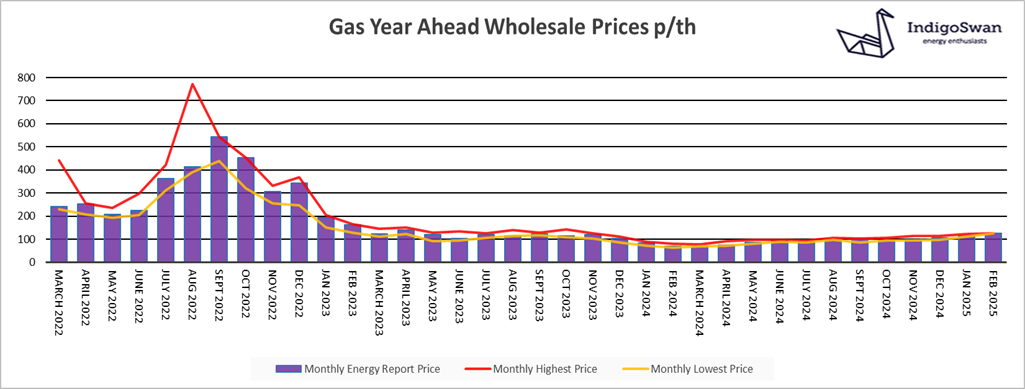
On the 3rd of February, the Gas Year Ahead Wholesale cost was 125.11p/th, up from 114.38p/th in last month’s report and 81% more than 2024.
Since mid-December, the price of Gas has been moving higher, despite some short periods of reductions. This trend is the result of a growing concern that Gas Storage levels are far lower than previous years. EU Storage, which has a significantly greater capacity than the UK, is just 53% full compared to 69% in 2024 and 71% in 2023. With the accelerating rate of withdrawals, there is a concern that the 90% full target by November 2025 will not be achieved, especially as there is less Gas, due to the end of Russian flows through Ukraine. Europe will need to compete on the global market and pay peak prices for any available LNG shipments from the likes of the US, Russia, Qatar and Australia, adding a price pressure through the rest of 2025.
Temperatures are expected to fall below seasonal norm over the next week, which will increase demand for heating and generation. We are waiting to see if the US will place sanctions on the EU and UK, and the impact on LNG deliveries. President Trump would like to see the EU buy more US LNG rather than from Russia.
We would encourage customers that have Gas or Electricity contracts ending in the first half of 2025, to discuss options with Indigo Swan and closely monitor the position.
Electricity market overview
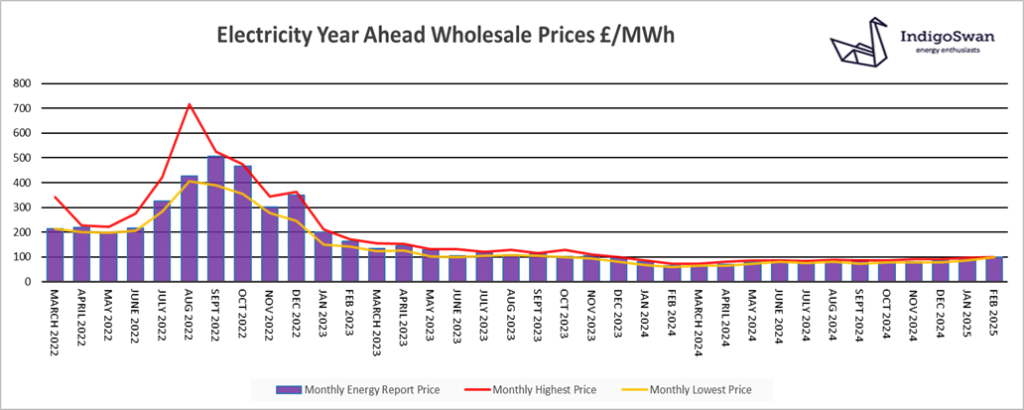
On the 3rd of February, the Electricity Year Ahead Wholesale cost was £100.20/MWh, up from £89.38/MWh in last month’s report and 56% more than 2024.
We continue to be very reliant on Gas to generate Electricity. Although it is just one of a number of sources, it remains reliable and flexible, compensating for reductions from the likes of Wind or helping to meet additional demand. In January Gas provided 40% of the mix, compared to just 31% in December and over 50% last Friday. This means that Electricity prices follow the direction of Gas and is why we have seen the renewed volatility, as Gas Storage levels are very low. Wind contributed 25% in the last week, but fell as low as 9%, whilst imports from Europe via the Interconnectors were 13%. In January 2024 Coal provided almost 2%, but our last Coal power station has closed.
With temperatures due to fall below seasonal norm, additional pressure will be applied to both Gas and Electricity, with the system potentially using a whole range of tools to avoid interruptions to power supplies. The high costs of these measures are included in Electricity bills, but they do avoid the need to build more generation for short periods of demand and provide the industry and consumers with confidence.
We would encourage customers that have Gas or Electricity contracts ending in the first half of 2025, to discuss options with Indigo Swan and closely monitor the position.
If you enjoyed reading this blog why not try one of our others: