

Headlines:
- Gas and Electricity Wholesale prices are lower than last month
- EU Gas Storage levels are lower at 38% full compared to 62% last year
- Concern at the cost to replenish EU Gas Storage for winter 2025/26
Energy Overview
As of the 4th of March, Gas and Electricity Year Ahead Wholesale costs were lower than in last month’s report.
February initially saw prices continue to climb as a number of global and domestic issues created volatility, the main concern being EU Gas Storage levels. When news broke that Presidents Trump and Putin had discussed peace talks, energy markets fell dramatically over a two-week period, before faltering. There is an expectation by some that should the conflict end, then Europe will receive more Russian Gas this year.
With EU Gas Storage at just 38% full compared to 62% last year, some EU nations asked that the 90% target by November 2025 be relaxed, along with a series of targets through the year. As gas prices were recently at an almost eighteen month high, the prospect of forcing the purchase of Gas for Storage, has been distorting the market. It appears that the request for the 90% level to be changed has been rejected, although there remains the possibility the interim targets may be more flexible.
Electricity’s price direction matched Gas due to our reliance on it for generation. This will continue until more Renewables are available, along with Storage to capture surplus supplies for future use. We will also need more Nuclear assets, a smarter grid and imports from the continent, if we are to break our dependence on Gas.
What does this mean for me?
The energy industry has changed how it recovers Electricity Distribution, Transmission and Balancing costs, under the Targeted Charging Review. This has moved some charges away from being based on the energy used and billed in the unit rate, to fixed charges incorporated within the Standing Charge or as separate items. This should give both the customer and the industry a more accurate way of calculating budgets, but the change has become noticeable within energy bills and created concern. Over the next two years, there is a quite confused picture of increases and decreases in Transmission and Distribution charges, which energy suppliers will be billing customers.
From April 2025 customers will see an increase in Transmission costs with an expectation of further increases from April 2026. Distribution costs are a little more complicated with the average fixed annual cost decreasing across networks from April 2025, remaining similar in 2026. Another element, the Available Capacity (AC), increases significantly for most from April 2025, with small reductions in 2026. This does mean that by managing the Agreed Supply Capacity, there is an opportunity to reduce the AC cost and longer term possibly lower the Band which determines fixed charges.
Balancing costs, which pay to fine tune Electricity supplies to avoid power cuts, will increase from October 2025.
Indigo Swan works closely with energy suppliers to help all our customers understand and manage changes.
Please contact us on 0333 320 0475 to discuss options or to get a latest update.
Gas market overview
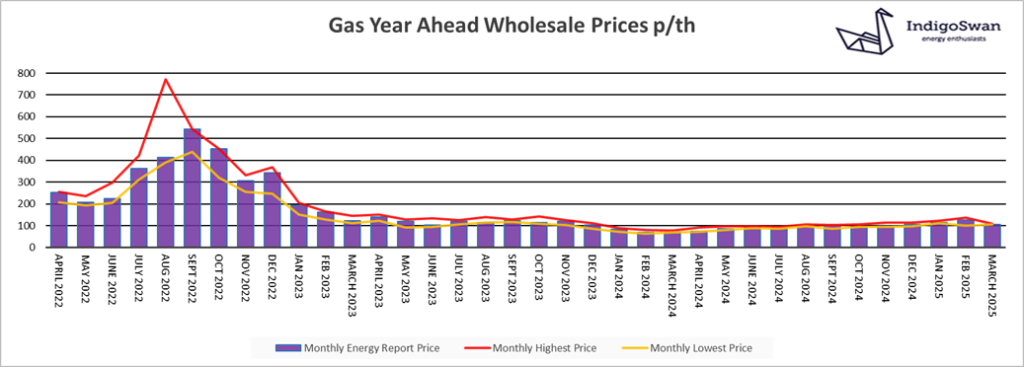
On the 4th of March, the Gas Year Ahead Wholesale cost was 105.12p/th, down from 125.11p/th in last month’s report and 51% more than 2024.
Gas prices continue to be focused on the level of EU Gas Storage, which is just 38% full compared to 62% last year. There are interim targets, but 90% is the goal by November 2025. Last year they peaked at 96%, which is currently looking very unlikely. EU members are concerned that these targets are adding pressure to buy and store Gas whilst prices are high, which adds further pressure. Appeals to adjust the 90% target did help prices to ease but have been dismissed by the EU. It is hoped that some flexibility on the interim targets will be allowed.
There is some optimism that peace talks between Ukraine and Russia may lead to a resumption of Gas flows into Europe. The uncertain outcome does mean that this could result in big price movements in either direction.
US LNG shipments to Europe have become very important since the end of the Ukraine Gas transit deal with Russia from 1st of January 2025. With the US adding sanctions to its biggest trading partners and despite President Trump wanting to export more LNG to Europe, it may be used to apply pressure in future negotiations.
We would encourage customers that have Gas or Electricity contracts ending in the first half of 2025 and potentially further out, to discuss options with Indigo Swan and closely monitor the position.
Electricity market overview
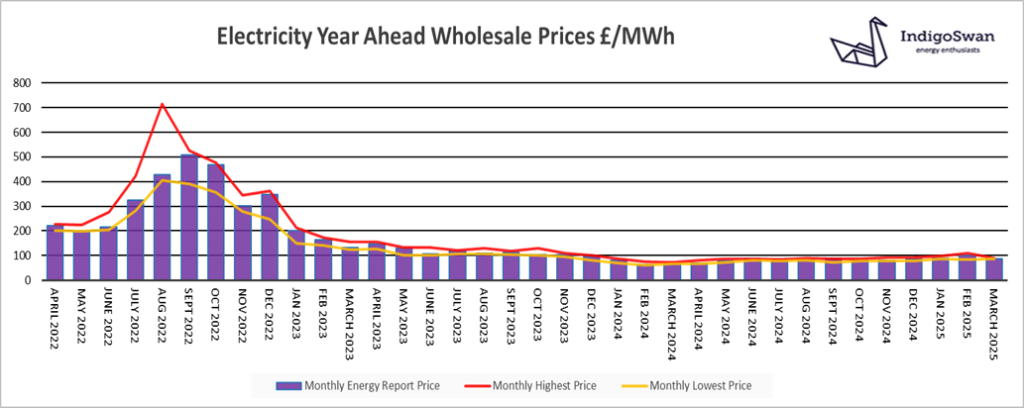
On the 4th of March, the Electricity Year Ahead Wholesale cost was £85.63/MWh, down from £100.20/MWh in last month’s report and 32% more than 2024.
The contribution of Gas to generation was lower in February at 35% compared to 40% in January. It was 37% over the last week. Wind was higher at 27% compared to 23%, with Imports from Europe via the Interconnectors at 16%.
Gas remains an expensive but reliable source of generation, compensating when both Wind and Solar are lower. This means that the Electricity Wholesale price direction follows Gas. There is concern that EU Gas Storage is low and the uncertainty of reaching the 90% full target by November 2025. Electricity prices remain high compared to 2020, but they are still significantly lower than most of 2021, 2022 and 2023.
From April 2025 the new Transmission and Distribution costs will apply, which will generally see increases for most customers. Those already on fixed price contracts will see no change, but are likely to notice differences on new contracts, especially with Half Hourly meters.
We would encourage customers that have Gas or Electricity contracts ending in the first half of 2025 and potentially further out, to discuss options with Indigo Swan and closely monitor the position.
If you enjoyed reading this blog why not try one of our others: