

Overview
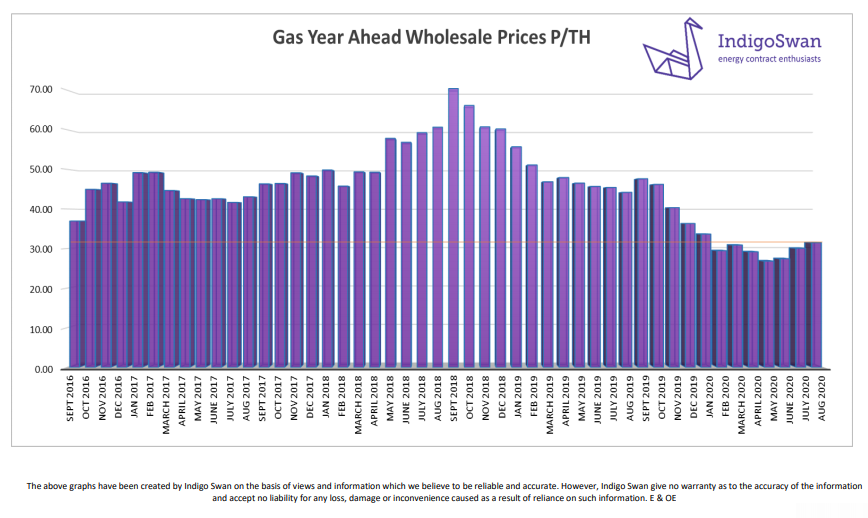
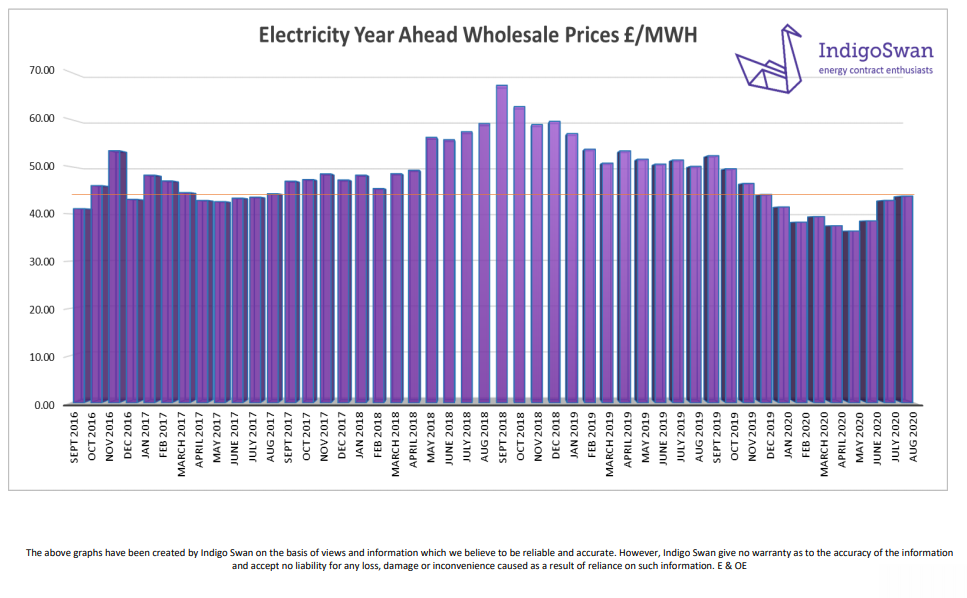
As of the 10th August, Gas and Electricity Year Ahead Wholesale costs are slightly higher when compared to last month’s report.
The price of Oil has been stable over the last month, moving from $43 a barrel to $44. OPEC+, which includes Saudi Arabia and Russia, agreed to reduce the extent of their production cuts from August. There had been growing confidence that we could see a return to normality and an upturn in Oil use, however, the increase in coronavirus cases means prices are still subdued. Political and trade disputes with China, add another concern for the global economy.
Gas Wholesale costs are higher but remain very competitive, as illustrated by our graph. July saw just six LNG deliveries and indications are, that August will see similar levels. This reflects a positive Gas position, with low prices giving LNG producers little incentive to sell, with reduced customer demand and high levels of Storage.
Electricity Wholesale prices are at 2017 levels. Wind’s contribution was down to 16% in July from 18% in June. February 2020 saw a record breaking 29%. Solar has also been lower over the last two months at 7%. This means there is a need to source more expensive forms of generation. Coal power stations made no contribution and will close by 2024 to help meet carbon reduction targets.
The Met Office forecast for the next month suggests warm weather with a risk of thunderstorms. This would mean a good Solar contribution but modest Wind and another month of high Gas use for generation, which adds pressure to Wholesale costs.
What does this mean for me…?
Wholesale prices show good value despite being higher. It should be remembered that this element makes up in the region of just 40% of the total cost of an Electricity bill. Gas is roughly 60%.
The influence of increasing third-party costs is noticeable in Electricity contracts. These include, Transportation, Distribution and government policy levies.
Over the next few years, the way some of these charges are calculated will change, under the Targeted Charging Review, although the details are not yet available. Initially the first change to Transportation costs was due April 2021, but with delays issuing price guidelines to energy suppliers, this has been postponed until April 2022. The planned change to Distribution charges is still set for April 2022. This does mean that the expected opening of some fixed priced contracts should not take place until 2022.
To benefit from the low Wholesale prices, we advise requesting supplier offers for all 2020 and early 2021 start contracts. Be aware that suppliers are tightening their credit requirements and reducing their risk appetite, but good forward contract options can still be negotiated.
Please contact us on 0333 320 0475 to discuss options or to get a latest update.
Gas Market
On the 10th August, the Gas Year Ahead Wholesale cost was 31.48 (p/th), from 30.07 (p/th) in last month’s report and 29% lower than 2019.
There were just six LNG deliveries in July, compared to an average of sixteen a month over the last year, with three so far in August. The impact of the coronavirus on demand has helped keep global prices low and storage levels high. LNG suppliers are therefore looking to cut back on production and see if they can benefit from a better price as economies recover or demand increases, as has recently happened in Asia due to higher temperatures.
Pressure has been applied once again to the Wholesale cost due an increased need for Gas use in Electricity generation, with Renewables underperforming. However, Gas Storage levels remain high and despite some outages, supply levels are good.
Oil has some historic contractual links with Gas prices. As oil prices stabilise and move higher, upward pressure could be felt in the Gas price.
Let us know if you would like us to research your options for 12, 24 and 36 month contracts.
Electricity Market
On the 10th August, the Electricity Year Ahead Wholesale cost was 43.77 (£/MWh), from 42.86 (£/MWh) in last month’s report and 13% lower than 2019.
Electricity demand recovered slightly in July as businesses have been allowed and attempted to resume activity, but was still in the region of 7% lower than 2019. This is reflected in a lower Wholesale cost. The reduced demand has meant another month without expensive Coal generation.
With Gas prices increasing and being the main source of generation, the Electricity Wholesale cost has followed upwards. The combined Wind and Solar contributions have been lower in recent months, adding a price pressure due to a greater need for the use of Gas. So far in August, Wind is just 15%, the lowest in a year.
Third Party Charges continue to increase regardless of how the Wholesale element changes. These charges typically pay for the mechanisms, securing generation at peak periods.
Let us know if you would like us to research your options for 12, 24 and 36 month contracts.