

As part of our Swan Sustainability Series we want to talk to different industries and what businesses are doing currently in terms of Net Zero and Sustainability, not only within their own companies, but how they are helping their customers with reducing their carbon footprint. We interviewed Derek MacDonald, Joint Managing Director at Newton Property Management to discuss the amazing work that they are doing within this area and their green vision.

We know that that Newton are really pushing the sustainability and the green agenda and you guys have got a green vision. We know that you are regularly recognised in the press up there in Scotland for all the great green work that you do. Could you just tell us a bit more about your green vision and how it came about?
Well I can’t do better than to say to anyone watching this to head over to our website and have a look at it. I think for us it was a eureka moment and a kind of realisation that we work in a fairly kind of solid, traditional kind of sector. Everyone in the sector is very comfortable with our boundaries and we just thought well let’s look at what we do and if there is any additional value that we can add.
We’re in a very privileged position as agents because we can help what’s called a guided narrative for our customers and we are in the age that we’re going into now where we need to get carbon emissions down. There’s really an obligation on us I think to be properly educated to know not only what our current boundaries are, but what we’re capable of doing, as long as we work with our customers. The green vision is all about taking things that we previously might have done and saying no we can do these now. We’ve set half a dozen very straightforward challenges for ourselves and we’re getting these done now and we’re making really good progress. We’re hopeful that others in the sector will follow but in their own way to suit their own businesses. It’s been a really galvanizing experience for the business and it’s been really heartening to see how everyone’s got behind this, everyone involved in the business, our customers and we’re just delighted that we’re going and there’s no end in sight.
You mention on your website about how customers are really getting on board with the green vision and everything that you’re doing from a sustainability angle, but what kind of steps do you think customers can take to reduce their own carbon footprints of their own properties? Are there actions that you’re doing to help them or are there things that they’re doing proactively themselves?
One of the first things that we really get stuck into was led light installations because it’s not just about the energy saving that you get from actually transforming a building from a reasonably tired building, with your old kind of d-ring fittings and then suddenly putting in these bright, modern led lights, it instantly drives down the electricity consumption and obviously that then has a knock-on effect for the carbon emissions but it actually transforms a look and feel of these buildings as well.
We’ve got one in Glasgow in the city centre, and this was quite an iconic building that was previously the offices of one of the national newspapers up here. We started managing it a couple of years ago and one of the first things we did was to say to the owners, look we can make massive savings here, you can transform the look and feel and what a difference. Other projects that we’re involved in include what we call the energy circle which is looking at solar panels, battery storage and EV charging. This is quite an exciting time to be involved in this because as a as a proposition to the building owners we’re really starting to make it like a business model for them to say look you know you particularly the larger buildings you’ve got the great capacity here to not only to drive down your carbon emissions but to actually earn some income that you can put back into the maintenance of the building. In the long term we’re beavering away in one of the buildings involved in that we’ve just reached an agreement with the owners to put in solar panels which will be the first phase of that this they’re also talking about EV charging and the battery’s a little bit more problematic because it’s really crucial for the price point but actually I’m really confident that changes to battery technology including solid-state batteries that’s really going to make a huge difference and it’s going to get that price point to a place where it makes sense. Then you’re going to see larger city centre developments not only generating their own power but earning an income from the yield to store power and then be able to resell it, but actually helping to stabilize the local grid network. As we know there’s going to be a huge demand for power from electricity as opposed to carbon based sources and vehicles as well so it’s just such an exciting time to be in this business.
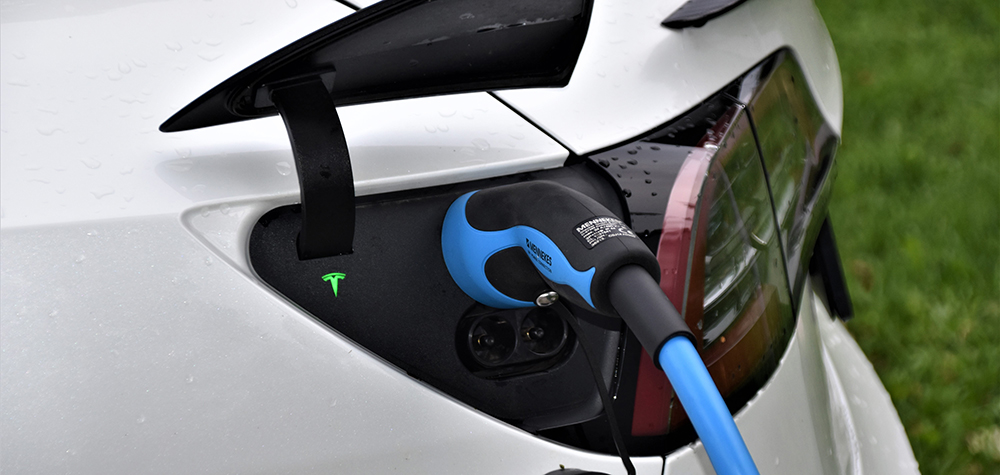
You mentioned EV and we’ve seen in some of your articles that you’ve made the comments about EV being as commonplace in the future as broadband connections which we will take for granted. Have you seen an increase in demand for EV at either existing or new developments that you’re looking after?
Yes it’s been unbelievable the last year with the amount of interest that that we’re getting, Newton have had pilot projects running and we’ve been really been trying to get behind customer projects ourselves and to actually help facilitate and make these things happen. I think the whole lockdown experience for many people has been quite an introspective experience they’ve really had a look at their lifestyles. For a lot of people it’s been quite liberating, having such a hectic lifestyle and commuting is a huge part of that. Not to have that commute but to have some extra time to think about how they’re going to live their lives everything seems to be kind of peaking towards the point here where the car manufacturers are getting their act together now. The governments are setting more and more ambitious targets for electric only or plug-in hybrid cars. Scotland were a little bit behind I think the UK Government setting a target of 2032 but it looks like that might come back to 2030 and I think that’s really focusing everyone’s minds on it, and the amount of interest we’re getting is phenomenal. We know that the housing developers that we deal very closely with are looking at this very closely. Local authorities are starting to structure in EV charging much more carefully into planning permission and the net result of this is what you’re seeing on the roads, you’re seeing many more EV vehicles which is great. They’re cheaper to run, they’re certainly nowhere near as polluting and it’s all going in the right direction and again coming back to the point earlier on about how we can help guide the narrative, we and people in our sector, we can be the go to knowledge base for our customers. So if they have a question about it, if they’re uncertain about anything, they can come to us and we’ll give them a completely unbiased view on what would be the benefits of swapping to an electric vehicle. For me the main thing is I really like them! I think they’re great! Gone are the days where electric vehicles used to be those two little tin pot two-seater tiny roller skate cars, you can get really nice vehicles nowadays. I mean there are certain compromises with electric vehicles but really it’s just down to time management and you know if you if you have an electric car and you’re charging it at home, it really is as simple as coming home plugging in.
It’s great to hear what you’re doing to help your customers and so let’s focus back on Newton and what you’re doing as a business. What steps are you guys actually taking to reduce the carbon footprint of Newton Property Management and are there any particular offsetting projects or carbon reduction initiatives that you guys are supporting?
So it’s slightly more difficult for us because we’re office based and you know what can we do with our core operation but a lot of the carbon that we produce is from our activities from our office so if we are sending out you know tens of thousands sometimes hundreds of thousands of pieces of correspondence every year, if they’re all going out by post they’re going out in the post they’re going to the van, the person’s driving the van, not to mention the carbon that’s created from creating the paper. So we’ve had a really intensive push for the last couple of years to try and persuade our customers to go into electronic mail and that’s been really successful. Approximately 70 percent of our customers are now receiving everything electronically and we think that there’s an awful lot of carbon being saved on that. Other things really come back to you know this idea about you know how we you know we try and guide the narrative. Just recently we helped a community group in Airdrie which is just outside Glasgow, to plant a community woodland. It was a bit of land that didn’t look great and the owner asked if we could do something with this, so we put our minds together and came up with this. We want to help our customers identify spare pockets of land within big housing developments because you know sometimes you know as convenient and as attractive as a new housing development can be and there’s still a lot of areas that can feel quite sterile and that’s really where we can get involved. We’ve got a great partnership with The Woodland Trust as well who’ve been really helpful to help us do these things.
What do you think is going to be what are the biggest challenges that the businesses and householders really face as the UK kind of progresses over the next couple of decades towards that net zero position?
Red tape! Definitely bureaucracy, that’s the biggest challenge that’s facing us as an industry to help facilitate these things and stopping customers and we really need to get a handle on this. We’ve really been trying to say as loudly as we can, we understand that legislation takes time to come into place but there really needs to be a focus on bringing forward and enabling communities to make decisions. So it doesn’t really matter where we are in the UK and we all have slightly different legal systems when it comes to property ownership but fundamentally if you want to put something new into a development that wasn’t there you’ve got to get permission for that. How do we make that as simple and as democratic as possible so that owners or leaseholders of properties can actually say okay this is how we want our development to look, this is what we want to do what’s the most democratic way to look at this and let’s take down the barriers to that let’s make it as straightforward as possible within the rules. I think it’s that really fine balance of what’s essential for safety, fairness and then what’s just a bit unnecessary and a bit cumbersome and having that balance. Leaseholders and property owners need to be aware that adding these additional services into the buildings can help save them money. It can help drive down their carbon emissions and actually improve the value of the property as well and that’s that that’s got to be a real driver for change.