

Headlines:
- Gas and Electricity Wholesale prices are lower than last month
- EU Gas Storage levels are 59% full compared to 77% last year
- June saw temporary price volatility due to the risk of disruption to Gas supplies
Energy Overview
As of the 30th of June, Gas and Electricity Year Ahead Wholesale costs were lower than in last month’s report.
The short conflict between Israel and Iran which started on the 13th of June, threatened to impact on the Export of Oil and Gas through the Strait of Hormuz. A ceasefire started on the 24th of June. During the period, Oil, Gas and Electricity prices increased dramatically, but have since fallen.
Other factors continue to influence prices, which include the very low EU Gas Storage levels, which are just 59% full compared to 77% last year. The industry will become increasingly nervous if Storage remains low as we approach the winter, especially if there are forecasts for periods of prolonged below average temperatures. With deadlines approaching to decide on US trade tariffs and the possible counter measures taken by nations, these may affect energy costs, depending on the impact on the global economy.
The contribution of Wind to generation was a high 27% in June, exceeding 40% on a number of days. This reduced the use of Gas from 22% in May to 19%.
OPEC+ looks likely to continue to increase Oil output, slowly reversing previous large decreases. Oil is currently $68 a barrel compared to over $90 in April 2024. Further price reductions may force some producers to pause production.
Other Industry Costs
The energy industry has changed how it recovers Electricity Distribution, Transmission and Balancing costs, under the Targeted Charging Review. This has moved some charges away from being based on the energy used and billed in the unit rate, to fixed charges incorporated within the Standing Charge or as separate items. This should give both the customer and the industry a more accurate way of calculating budgets, but the change has become noticeable within energy bills and created concern. Over the next two years, there is a quite confused picture of increases and decreases in Transmission and Distribution charges, which energy suppliers will be billing customers.
From April 2025 customers will see an increase in Transmission costs with an expectation of further increases from April 2026. Distribution costs are a little more complicated with the average fixed annual cost decreasing across networks from April 2025, remaining similar in 2026. Another element, the Available Capacity (AC), increases significantly for most from April 2025, with small reductions in 2026. This does mean that by managing the Agreed Supply Capacity, there is an opportunity to reduce the AC cost and longer term possibly lower the Band which determines fixed charges.
Balancing costs, which pay to fine tune Electricity supplies to avoid power cuts, will increase from October 2025.
Indigo Swan works closely with energy suppliers to help all our customers understand and manage changes.
Please contact us on 0333 320 0475 to discuss options or to get a latest update.
Gas Market Overview
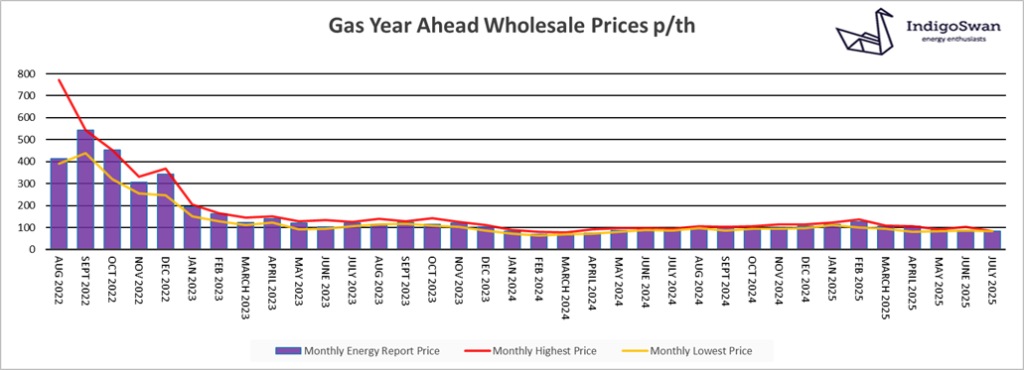
On the 30th of June, the Gas Year Ahead Wholesale cost was 84.81p/th, down from 88.04p/th in last month’s report and 9% less than 2024.
There was significant price volatility for almost two weeks in June, when it was feared that the conflict between Israel and Iran could mean the closure of the Strait of Hormuz. Any disruption to the large volumes of Oil and LNG would have a big impact on tight global supplies, so markets temporarily were building an element of this concern into prices. LNG remains an important source of Gas supplies both for Europe and Asia.
The EU has moved a step closer to changing the Gas Storage target, which is currently 90% full by the 1st of November. Should it be approved, the new target would need 90% to be reached between the 1st of October and the 1st of December, potentially with some flexibility. EU Storage is just 59% full compared to 77% last year and with less Russian Gas being available due to the closure of the transit route through Ukraine, the target may be challenging. If there are forecasts for extended periods of very cold conditions across Europe this winter, then we would expect markets to include a higher risk premium.
We would encourage those with Gas and Electricity contracts that are due to end in the next few months and potentially further out, to engage with Indigo Swan and monitor positions closely.
Electricity market overview
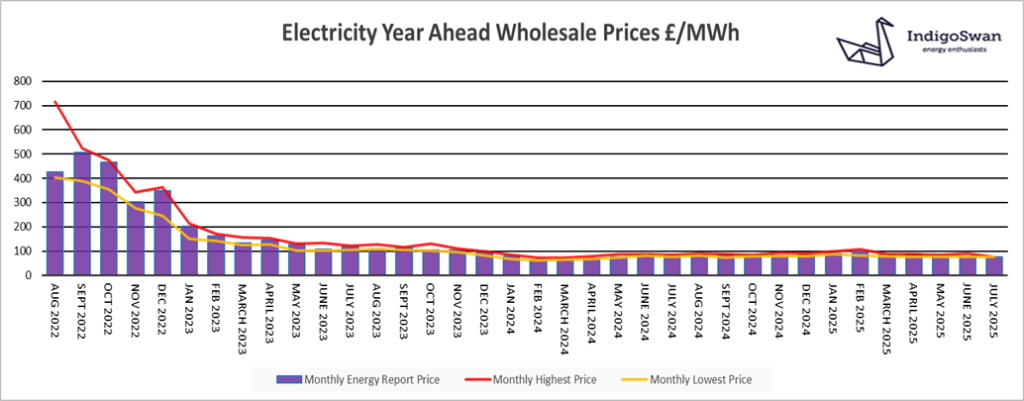
On the 30th of June, the Electricity Year Ahead Wholesale cost was £76.00/MWh, down from £79.12/MWh in last month’s report and 7% less than 2024.
The conflict between Israel and Iran, with its potential impact on Gas supplies and the subsequent price increases, meant Electricity costs followed due to its use for generation. With the ceasefire reducing the threat of the closure of the Strait of Hormuz, prices fell sharply.
Wind provided a high 27% of supplies in June, up from 23% in May. This meant a lower contribution from both Gas at 19% and Imports at 16%. Industry forecasts suggest that there should be additional spare capacity in the UK this winter, partly due to increased Battery Storage, Gas generation and connectivity through the Interconnectors.
The government’s decision for the future of Electricity Wholesale pricing is due soon, which will determine whether we continue as we are, with a national price or move to Zonal prices, where they are determined primarily by the distance from generation. Any change will be a long-term project, with delivery in 2030 or beyond.
We would encourage those with Gas and Electricity contracts that are due to end in the next few months and potentially further out, to engage with Indigo Swan and monitor positions closely.
If you enjoyed reading this blog why not try one of our others: