


Headlines:
- Gas and Electricity Wholesale prices are lower than last month
- A number of potential Gas supply issues are adding a premium to prices
- EU Gas Storage levels are a high 94% full
Energy Overview
As of the 1st of October, Gas and Electricity Year Ahead Wholesale costs were lower than those in last month’s report.
We saw a downward price trend early September which was a reflection of the positive outlook for Gas and Electricity supplies. Unfortunately, a series of events has once again seen prices move higher.
The situation in the Middle East has deteriorated with Israel now in conflict with a number of its neighbours. As yet this has not had an impact on Gas and Oil supplies from the region, but the possibility is being factored into costs by the energy markets. We also saw a considerable downward price movement when it was reported that an alternate route for Russian piped Gas supplies had been agreed, as Ukraine is ending the current deal this year. The news was found to be incorrect, and prices moved higher. The current cold spell and the speculation that November could see below seasonal normal temperatures, are both adding pressure to prices.
The positive news is that EU Gas Storage levels remain high at 94% full, already above the 90% target for November. However, should there be more Gas disruptions, continued low LNG deliveries and a prolonged period of very low temperatures, then energy markets will likely show further volatility. Although there will always be concern for the coming winter, thoughts are already turning to how Gas Storage levels will look in 2025, should Gas supplies be reduced.
What does this mean for me?
The energy industry has changed how it recovers Electricity Distribution, Transmission and Balancing costs, under the Targeted Charging Review. This has moved some charges away from being based on the energy used and billed in the unit rate, to fixed charges incorporated within the Standing Charge or as separate items. This should give both the customer and the industry a more accurate way of calculating budgets, but the change has become noticeable within energy bills and created concern. Over the next two years, there is a quite confused picture of increases and decreases in Transmission and Distribution charges, which energy suppliers will be billing customers.
From April 2024 most customers saw a decrease in Transmission which is likely to be followed by an increase in this fixed charge from April 2025, almost completely replacing what used to be recovered through Triads. Distribution costs are a little more complicated with the average fixed annual cost increasing across networks from April 2024 but decreasing from April 2025. Another element, the Available Capacity (AC), has already seen small increases but is due for a more significant rise from April 2025. This does mean that by managing the Agreed Supply Capacity, there is an opportunity to reduce the AC cost and longer term, potentially lower the Band which determines fixed charges.
There is an expectation that Balancing costs will continue to increase.
Indigo Swan works closely with energy suppliers to help all our customers understand and manage changes.
Please contact us on 0333 320 0475 to discuss options or to get a latest update.
Gas market overview
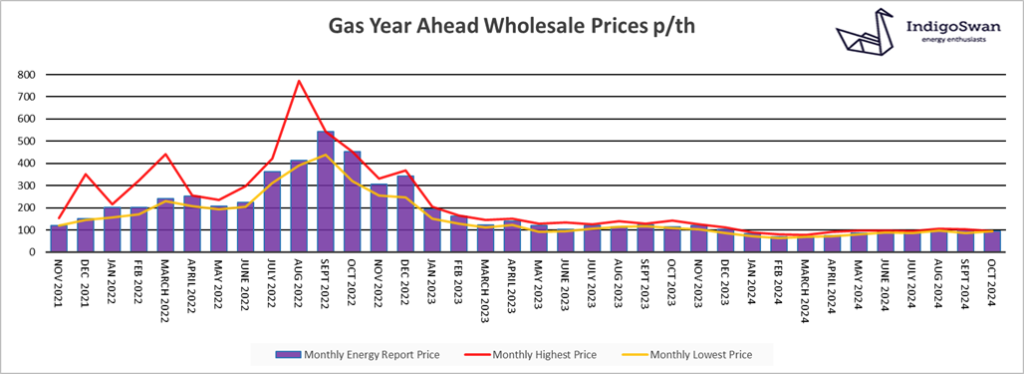
On the 1st of October, the Gas Year Ahead Wholesale cost was 95.97p/th, down from 100.55p/th in last month’s report and 17% less than 2023.
Prices continue to factor in potential issues with Gas supplies as we head towards the winter and a higher demand for heating and Electricity generation. EU Gas Storage levels are a high 94% full despite continued disruption to Norwegian Gas supplies and a reduction in LNG shipments due to global competition, notably from Asia where temperatures have required additional Electricity generation for air cooling.
The transit agreement between Ukraine and Russia will end this year. Unless a new route is agreed, then Europe will see a further reduction in piped Gas. This may cause issues should there be a prolonged extreme cold spell, but a number of nations see this as an acceptable position as it will achieve what EU’s sanctions have failed to. It was wrongly reported that an alternate arrangement had been found, which had a short-term positive impact on prices. Other factors adding value to prices include the worsening conflict in the Middle East, the Ukraine / Russian war and hurricanes in the US.
The direction of Wholesale prices is uncertain with a number of events potentially either reducing Gas supplies or increasing demand. We would advise discussing your options for contracts ending in 2024 and early 2025 or at least monitoring the position closely.
Electricity market overview
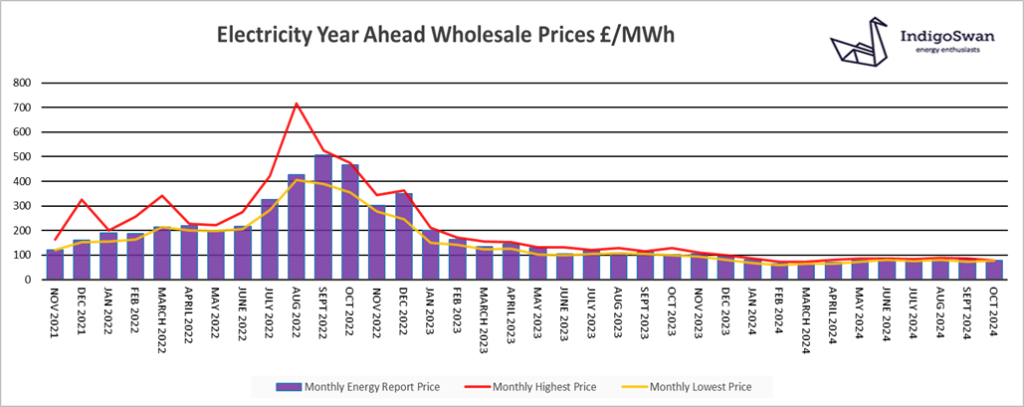
On the 1st of October, the Electricity Year Ahead Wholesale cost was £79.33/MWh, down from £85.19/MWh in last month’s report and 23% less than 2023.
With Renewables being so erratic, Gas is an important form of generation due to its flexibility, but it is also expensive and so sets the direction of Electricity Wholesale costs. Therefore, the current concerns being factored into Gas prices, which includes the tensions in the Middle East, the war between Ukraine and Russia, lower Russian Gas supplies in 2025, reduced LNG deliveries and colder temperatures, are all having an impact on Electricity prices.
The contribution of Wind to generation decreased in September to 21%, which meant a greater use of Gas, and Electricity Imports from Europe via the Interconnectors. Over the last week Wind has been higher at 29% and Gas reduced to 25% of supplies. The UK’s last Coal power station has closed. Although it has frequently not been used, Coal still contributed an average of just under 2% of supplies last winter.
The direction of Wholesale prices is uncertain with a number of events potentially either reducing Gas supplies or increasing demand. We are also vulnerable to reduced Imports of Electricity from Europe, with historic issues such as French Nuclear reactors going offline and low water levels impacting on Norway’s Hydro Exports. We would advise discussing your options for contracts ending in 2024 and early 2025 or at least monitoring the position closely.
If you enjoyed reading this blog why not try one of our others: