

A pass-through energy contract splits your bill into two parts, the “fixed” power element, which you pay throughout your term, and non-commodity costs, which will vary over time. The basic ideas is that your energy supplier will pass these non-commodity costs direct to you and there is the risk that these are to some extent, unknown. The other option is to fully fix the majority of these costs at the point of contracting to give you greater control over your finances.
Long term energy contracts can last up to five years and can allow you to lock in a fixed energy price, however a long-term contract is likely to only benefit you if you know how much energy you are going to use over the period. Should your business usage be higher or lower than the tolerances agreed within your contract, you could face additional charges from your energy supplier.
If your energy contract is coming to an end and you’re not sure which option to choose, “fully fixed” or “pass-through”, contact us to speak to one of our friendly swans who will be happy to talk you through your options and which one is the best for your business.
Wholesale prices for 2021 onwards
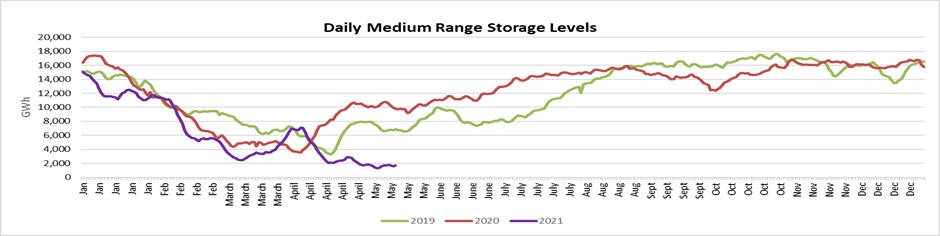
At present, wholesale prices for all periods are showing a premium, although 2021 contract starts are most impacted. This is due largely to the very low Gas Storage levels not just here but across Europe.
We are in this position due to the prolonged periods of cold weather, a shortage of LNG deliveries (which had been heading to Asia) and with unplanned technical issues reducing Gas supplies into the UK. Linked to this are the low amounts of Wind generation, which adds pressure for Gas to also be used for Electricity generation as well as domestic heating.
The graphs below illustrate that the markets are looking much more positively on contracts starting 2022 and 2023, but still show a premium. Indigo Swan will take a measured approach, putting the customer’s position at the heart of the decision whether to look at short or longer-term contracts. We provide customers with options.
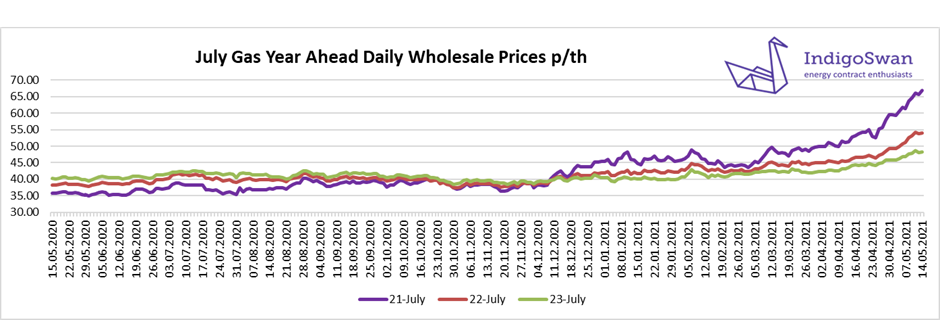
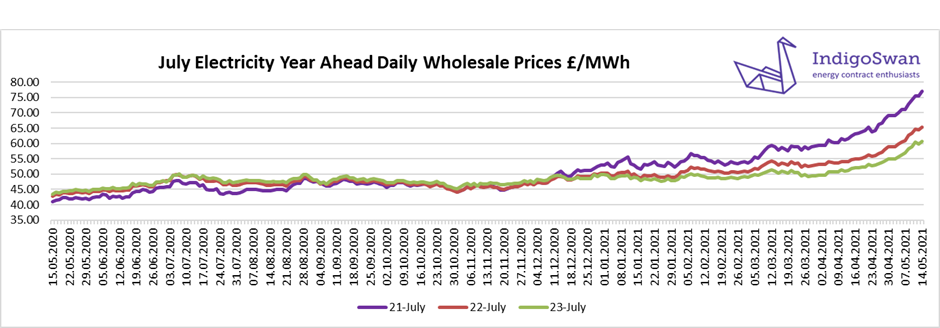
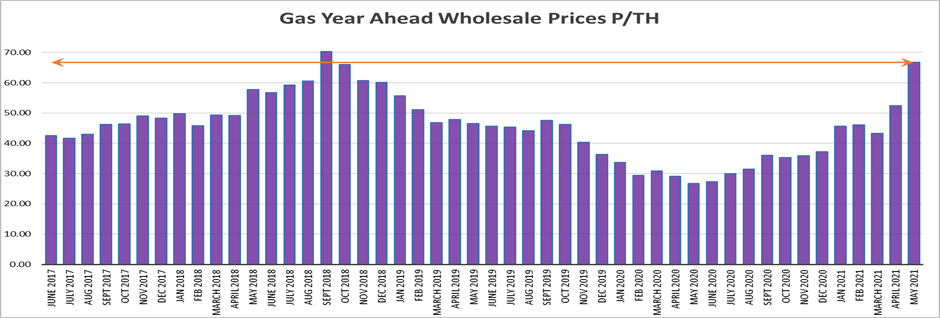
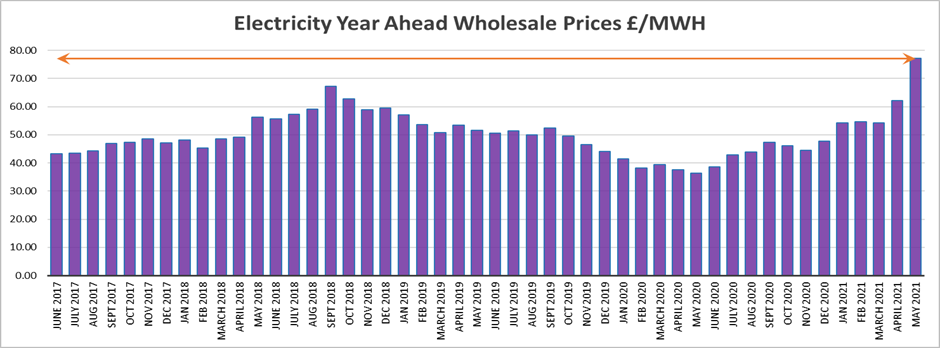
Below shows that over a long period, Wholesale prices have and will continue to react to a number of issues, many of which cannot be predicted, but they are both local and global.
Looking at the Wholesale prices now, it would be fair to assume that at some point they should fall back to the much more reasonable levels seen in 2017, 2019 and 2020.
Third Party Charges
Regarding Third Party Charges, the cost of some of the schemes will reduce over time as they have closed to new entrants. Other schemes look to secure Electricity generation through auctions and guaranteeing prices, allowing investment, so the longer-term effect of these cannot really be predicted.
There is significant investment in, for example Wind, which should see a cheaper Wholesale price which may be offset, to some degree by costly more reliable forms of generation such as Nuclear.
Nuclear prices in isolation should not be seen as examples of where prices will be. Transmission and Distribution costs are tightly controlled by the government.
Targeted Charging Review
The Targeted Charging Review which comes into effect April 2022 (Distribution) and likely April 2023 (Transmission) will not increase these charges as a whole but change how they are apportioned between customers.
With the current high Wholesale price for Gas and Electricity, Indigo Swan would certainly ask customers to consider not entering contracts too far ahead.
If you have any queries or concerns over your energy contracts, please get in touch with us to see how we can help.